How to See If AI Mentions Your Brand
Learn how to check whether ChatGPT and other AI search engines mention your brand, then turn a one-off check into ongoing AI visibility tracking.
Published September 22, 2026 · 9 min readThe quickest way to see if AI mentions your brand is to ask it the same questions your customers would.
Open ChatGPT, Perplexity, Gemini or another AI search engine. Ask a question like "What are the best [product category] for [use case]?" and see whether your brand appears.
That gives you an answer. It doesn't give you a measurement.
AI-generated answers can change between engines and between runs. Your brand might appear today and disappear tomorrow. A competitor might be recommended for one use case but absent from another.
So if you want to understand your actual AI visibility, you need a repeatable set of prompts, competitors to benchmark against and a way to track the answers over time.
Here's how to do it.
1. Start with a manual AI mention check
You don't need software to answer the first question: does AI mention my brand at all?
Start with 10–20 questions a potential customer could realistically ask before choosing a company or product in your category.
If you sell running shoes, for example:
- What are the best running shoes for marathon training?
- Which running shoes are best for beginners?
- What are good running shoes for people with wide feet?
- Which brands make the best trail running shoes?
- What running shoes have the best cushioning for long distances?
The important part is that these are non-branded prompts.
Asking "Is Nike a good running shoe brand?" tells you whether an AI knows about Nike. Asking "What are the best running shoes for marathon training?" tells you whether Nike is visible when the user hasn't already decided which brands to consider.
Run the same questions through the AI engines that matter to your audience.
Then record what happens.
A basic spreadsheet could contain:
| Date | Engine | Prompt | Brand mentioned? | Position | Competitors | Framing | Sources cited |
|---|---|---|---|---|---|---|---|
| Sep 25 | ChatGPT | Best running shoes for marathon training | Yes | 2 | Adidas, Brooks | Recommended | runnersworld.com |
Don't stop at yes or no.
Where your brand appears in the answer matters. So does whether you're recommended, listed neutrally or mentioned with a caveat.
Prompt tracking
What are the best running shoes for marathon training?

Nike's Air Zoom Pegasus is a top pick for marathon training, with outstanding cushioning and durability for long runs. Adidas Ultraboost delivers responsive energy return, and Brooks Ghost provides reliable support for high-mileage weeks.
Brands detected
Your brand
Competitor
Untracked
2. Check which competitors AI mentions instead
Your own mention rate doesn't mean much without context.
Imagine your brand appears in 30% of the prompts you test. Is that good?
It depends.
If your closest competitors appear in 10%, you're comparatively visible. If they appear in 70%, you have a very different problem.
This is why competitor tracking should be part of the setup from the beginning.
Pick the brands customers would realistically compare with you. These aren't always identical to your traditional SEO competitors.
Then look for prompts where:
- your competitor appears and you don't
- both brands appear, but your competitor is mentioned first
- your competitor is actively recommended while you're only listed
- different competitors dominate different topics or use cases
Those gaps are often more useful than an overall visibility number.
They tell you where your visibility problem exists.
3. Build a prompt set worth monitoring
A handful of manual searches gives you an initial snapshot. The next step is deciding what you want to measure repeatedly.
Your prompt set should represent the questions that matter commercially to your business. Choosing the right prompts to track is worth doing properly rather than guessing.
Good sources include:
- Google Search Console queries
- People Also Ask results
- paid search terms
- sales calls
- support questions
- customer interviews
- product and category searches
- questions customers ask before choosing between you and a competitor
Group related prompts together.
For a running shoe brand, you might have prompt groups such as:
Marathon running
- Best shoes for marathon training
- Best marathon shoes for beginners
- Most comfortable shoes for long-distance running
Trail running
- Best trail running shoes
- Waterproof trail running shoes
- Trail shoes with good grip
Everyday running
- Best running shoes for daily training
- Comfortable running shoes for beginners
- Best cushioned running shoes
This makes the data easier to interpret later.
You might discover that your overall visibility looks healthy while your brand is almost completely absent from an important product category.
Don't change your prompts every time the results change
Once you start measuring, keep a core set of prompts stable.
AI responses naturally fluctuate. If you continuously rewrite your prompts, you won't know whether your visibility changed or your measurement changed.
You can add new prompts as you learn more, but keep your baseline intact.
4. Run the same prompts across multiple AI engines
Checking ChatGPT alone gives you your visibility in ChatGPT.
It doesn't give you your visibility in AI search.
Different AI engines can return different brands, recommendations and sources for the same question.
Try running an identical prompt through ChatGPT, Perplexity, Gemini and Google AI search experiences.
You may find that one engine consistently mentions your brand while another prefers a competitor.
This is useful information.
Instead of asking:
"Are we visible in AI?"
You can start asking:
"Why are we consistently visible for this topic in one engine but missing from another?"
That gives your SEO, content and digital PR teams something concrete to investigate.
5. Turn the snapshot into monitoring
This is where manually checking prompts starts becoming painful.
Twenty prompts across four engines already creates 80 responses per run. It's also worth asking how many prompts you actually need to track before the set grows out of hand.
Run them several times per week, add competitors and retain historical answers, and the spreadsheet grows quickly.
More importantly, the value comes from comparing runs over time.
A single answer tells you what happened once.
Monitoring lets you see:
- how often your brand appears
- whether your visibility is increasing or decreasing
- where in the answer you're mentioned
- which competitors appear alongside you
- which prompts competitors win
- how your brand is described
- which pages and domains AI cites
- how the same prompt differs between engines
That's the point where an AI visibility tracking platform becomes useful.
How to track brand mentions with Vercite
Vercite turns the manual process above into an ongoing monitoring setup.
The workflow is deliberately close to how you'd approach the problem manually.
Step 1: Add your brand
Start by adding your brand and website.
This establishes the entity you want to monitor and gives Vercite context about your company and category.
You can also choose the market and language you want to measure.
Brand configuration
Step 2: Choose your competitors
Next, add the companies you want to benchmark against.
Vercite can suggest relevant competitors during setup, or you can add your own.
This is important because AI visibility is easier to interpret comparatively.
Knowing that you were mentioned 42 times becomes much more useful when you can see that Competitor A was mentioned 68 times and Competitor B was mentioned 27.
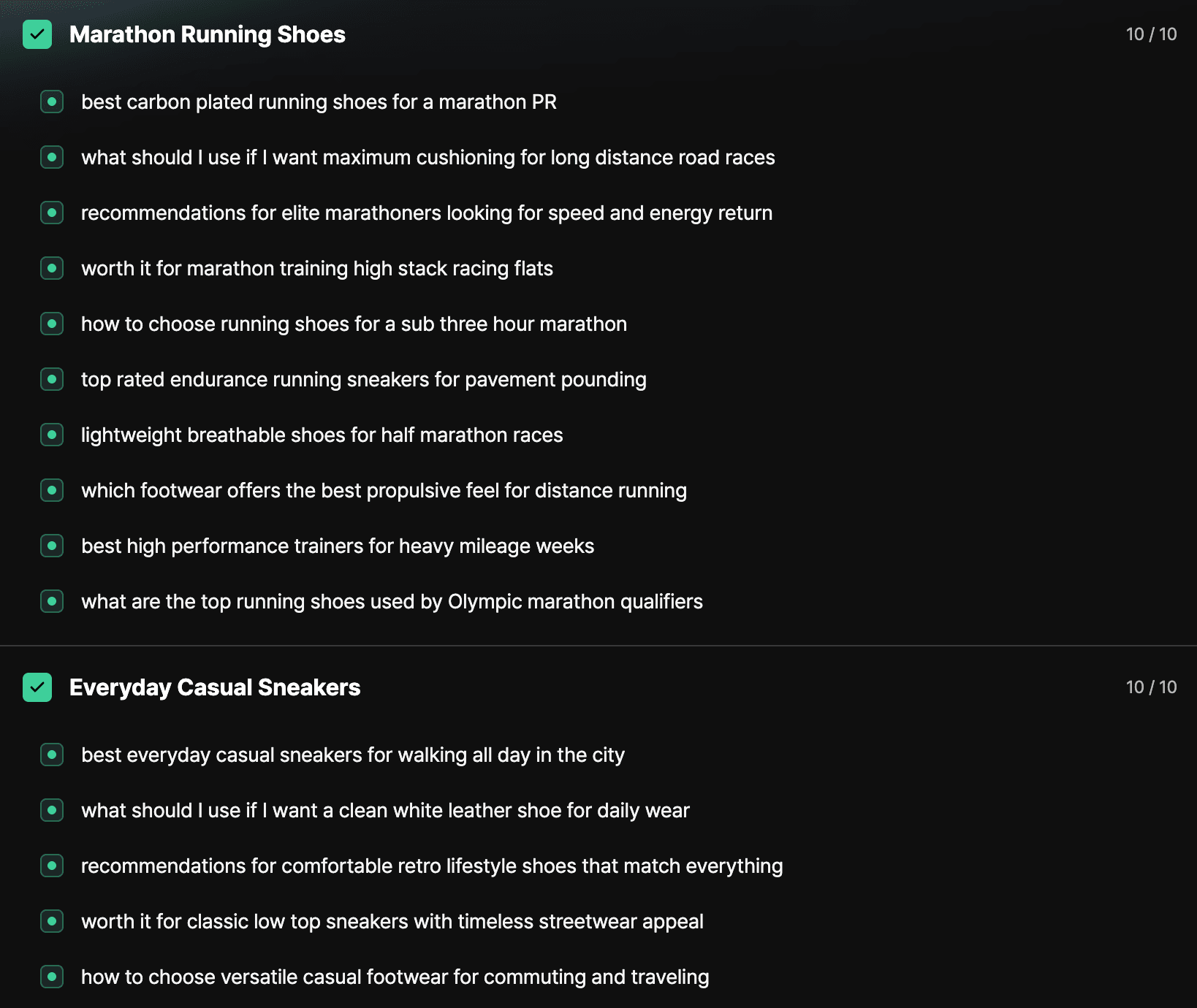
Step 3: Generate or add prompts
Add the questions you want to monitor.
You can create your own prompt set or use Vercite to generate relevant prompts based on your brand and category.
We still recommend reviewing generated prompts before tracking them.
The best prompt library reflects how your actual customers research products, compare alternatives and solve problems. No automatic generator knows your customers as well as your sales, SEO and support data does.
Organize prompts with tags so you can compare visibility by topic rather than looking only at one overall number.
Step 4: Start monitoring
Once monitoring starts, Vercite repeatedly runs those prompts and stores the responses.
Instead of manually opening each AI engine, copying the answer into a spreadsheet and checking for brands, you can follow the results over time from one place.
You can drill down from overall AI visibility into individual prompts and inspect the actual answer behind the metric.
AI Visibility
By AI engine
Recent insights
Now ranked #1 on Perplexity for "best trail running shoes"
2h agoAdidas gaining ground in ChatGPT, up 8 pts this week
5h agoVisibility score hit an all-time high of 67% across all models
1d agoThis matters when something changes.
If your visibility drops, the useful question isn't only how much did it drop?
You want to know which prompts changed, which competitors replaced you, what was said instead and which sources were involved.
What should you look at beyond brand mentions?
Whether your name appears is the starting point. There are several other AI visibility metrics worth checking.
Where your brand appears
A brand mentioned near the beginning of an answer can have a different level of prominence than one included as an afterthought further down.
Tracking mention position helps separate simple presence from stronger visibility.
How your brand is framed
Read the answer.
Is your company recommended?
Is it described as one of several options?
Is it positioned for a specific use case?
Is the wording neutral or negative?
Two brands can have identical mention counts while being represented very differently. This is worth tracking on its own – you can measure how AI frames your brand alongside whether it mentions you at all.
Which competitors appear
Look for consistent patterns.
If one competitor repeatedly appears for prompts about enterprise customers while another dominates beginner questions, the problem becomes much easier to diagnose.
What AI cites
Brand mentions and citations are different things.
An AI engine can mention your brand without citing your website. It can also use third-party pages when constructing an answer.
Look at the domains and pages being cited around the prompts you care about.
If competitors keep appearing while the same handful of review sites, publications or community pages are being cited, those sources are worth investigating. It's also worth checking whether your domain can be cited without your brand being mentioned – that's a distinct, common pattern.
What do you do if AI doesn't mention your brand?
Finding that you're invisible for an important group of prompts is useful.
Now you have something specific to work on.
Start with the prompts where competitors appear and you don't.
Read the answers and inspect their citations. Look at how competing brands are described and what information the cited pages provide.
You might find that:
- your site doesn't clearly cover the use case
- competitors have stronger third-party coverage
- comparison and review sites consistently mention competitors instead
- your positioning isn't clear enough for the category
- important information about your product is missing or outdated
- AI engines associate your brand with a different topic than the one you're trying to compete in
Then make changes where the evidence points.
Update or create useful content. Improve product and category information. Work on relevant third-party coverage. Make your positioning clearer.
Then keep running the same prompts.
That's how you find out whether anything changed.
A one-off AI search is useful. A trend is better.
If you've never checked your brand in AI search, start manually.
Write down 10–20 real customer questions. Run them through a few AI engines. Record your brand, competitors, framing and citations.
You'll learn something immediately.
But don't confuse that first check with measurement.
To understand whether your AI visibility is improving, you need to run the same questions repeatedly, compare yourself with competitors and keep the underlying responses.
That's the basic idea behind AI visibility tracking.
Vercite automates that process: add your brand, choose competitors, create your prompts, then monitor how your brand appears across AI search over time.

Builds Vercite and writes most of its research and case studies.
LinkedInHow to Choose Prompts to Track for AI Visibility
Learn how to find and choose prompts to track for AI visibility using Google Search Console, keyword data, customer pain points, People Also Ask and real buyer questions.
BlogWhy Your Domain Gets Cited in AI Answers but Your Brand Doesn't
Your website can be cited by ChatGPT, Gemini or Perplexity without your brand appearing in the answer. Learn why it happens and how to increase brand mentions in AI answers.
ResearchHow many brands does AI mention in its answers?
Across 234,000+ responses, ChatGPT mentions the most brands and Perplexity the fewest. Every engine mentions fewer brands than in March, and day-to-day consistency varies enormously.
See how AI engines describe your brand
Vercite tracks your mentions, citations and sentiment across ChatGPT, Gemini, Perplexity and Google AI – on a schedule, not a spot check.