How Many Prompts Do You Actually Need to Track AI Visibility?
How many prompts do you need for reliable AI visibility tracking? Learn why prompt coverage, repeated runs, tracking cadence and time matter more than one magic number.
Published August 25, 2026 · 8 min readIf you want a useful AI visibility baseline, you probably don't need hundreds or thousands of prompts.
For many brands, 30–70 well-chosen prompts tracked consistently can tell you far more than a database of hundreds of near-duplicates. The number becomes meaningful when those prompts cover distinct customer questions, are grouped into relevant topics, and are run repeatedly over time.
If you want to prove that a specific change caused a small improvement with statistical confidence, the requirements are different. Then you need to think in terms of prompts, repeated runs, time periods and individual AI engines.
Those are two different measurement problems.
There is no magic number of AI prompts
Asking "how many prompts do I need?" sounds like a sample-size question.
Partly, it is. But raw prompt count misses several things:
- Are the prompts genuinely different, or ten variations of the same question?
- How many topics or customer intents do they cover?
- How often are they run?
- How many weeks of data do you have?
- Are you analysing ChatGPT separately from Gemini or Perplexity?
- Are you monitoring a trend, or trying to prove that an intervention caused a change?
A set of 200 badly chosen prompts can give you a distorted picture of your market. A smaller set representing the questions your customers genuinely ask can be much more informative.
Cloro makes an important distinction here: variance between different prompts can be larger than variance between repeated runs of the same prompt. Adding another genuinely distinct customer question therefore gives you something that repeatedly rephrasing an existing one does not.
This is why prompt selection matters as much as prompt count.
Think in topics before you think in prompts
A single prompt is an unstable unit of measurement.
Imagine you track:
What are the best running shoes for a first marathon?
Your brand appears today and disappears tomorrow. Did your visibility fall?
Probably not. AI-generated answers naturally vary.
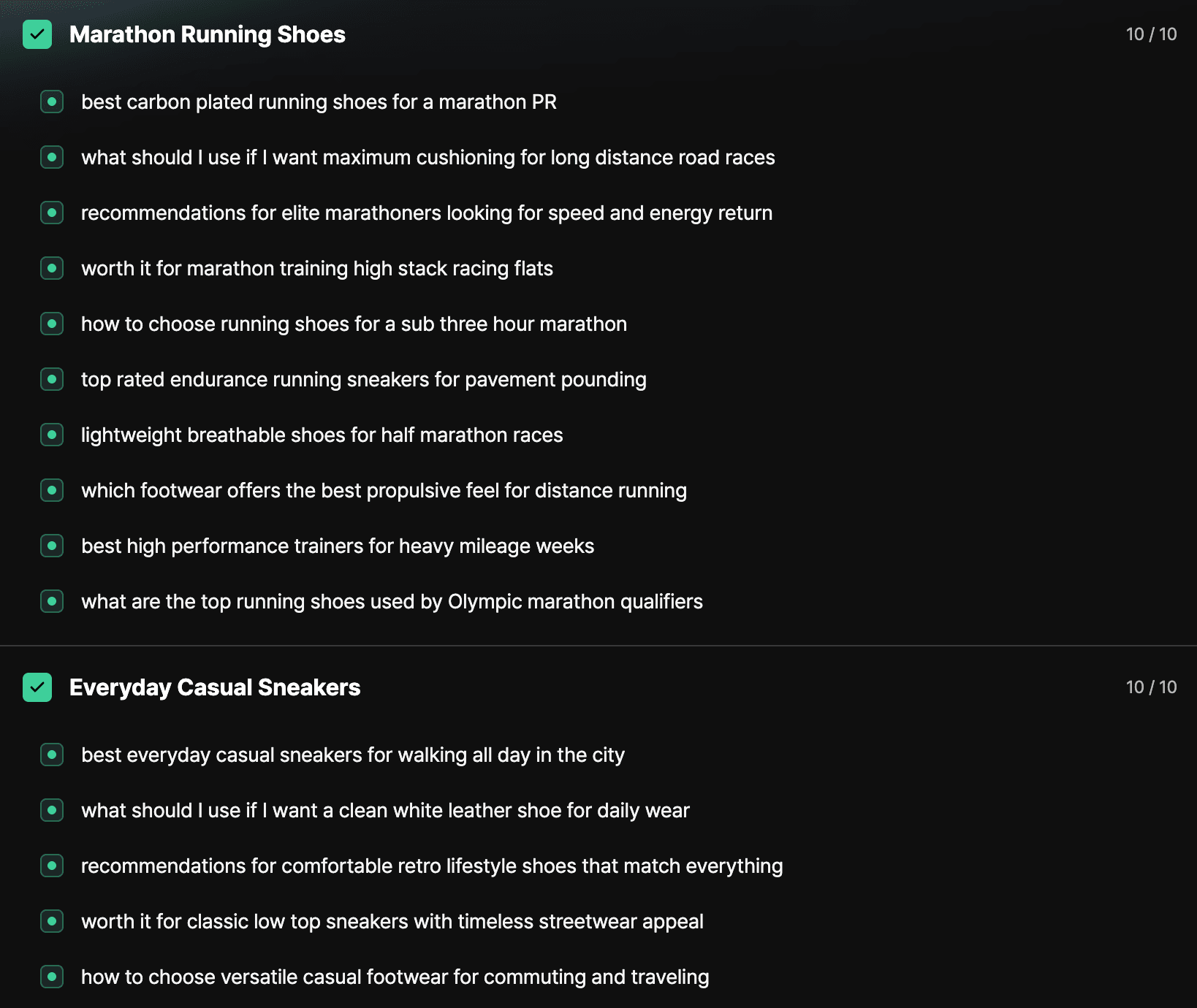
A better measurement unit is a topic containing several relevant prompts:
Marathon running shoes
- What are the best running shoes for a first marathon?
- Which running shoes are good for beginners training for a marathon?
- What running shoes are best for long-distance road running?
- Which shoes should I choose for marathon training?
- What are comfortable running shoes for a first-time marathon runner?
Now you're measuring whether the brand repeatedly appears across the underlying customer need rather than whether it appeared in one answer.
Obsero recommends this topic-level approach and suggests roughly 15–20 prompts per topic as a practical floor in its methodology. Its example shows how aggregating prompts and repeating them over time produces a much more stable topic-level reading than treating one prompt as the metric.
The exact number per topic isn't universal. Some categories contain far more distinct customer decisions than others.
The important part is coverage without duplication.
30 good prompts can be better than 300 near-duplicates
Suppose you sell accounting software.
These are technically separate prompts:
- What is the best accounting software?
- Which accounting software is best?
- What's the best software for accounting?
- Recommend the best accounting software.
- What accounting software should I use?
Running all five isn't useless. Wording changes can affect AI responses.
But they still represent roughly the same intent.
Your next prompt is probably more valuable if it covers something different:
- Best accounting software for a small consultancy
- Accounting software that integrates with Shopify
- Alternatives to Xero for a Swedish company
- Accounting software for handling multiple currencies
- Easiest accounting software for someone without an accounting background
Your prompt library now measures a larger portion of the decision space.
This is also why simply generating thousands of prompt variants doesn't automatically improve AI visibility measurement. You can increase the row count while barely increasing what you're learning.
Repeated runs matter too
Prompt breadth solves one problem: coverage.
Repeated runs solve another: variability.
Ask the same AI engine the same question several times and you can get different brands, sources and wording. Cloro's paired-run research found substantial citation variation between repeated answers, while Gumshoe's research similarly argues that individual responses vary but aggregate brand frequencies become more stable as the sample grows.
This makes a one-off visibility check weak evidence.
Tracking the same prompt set on a fixed schedule produces a time series instead.
Consider a 30-prompt set:
| Tracking setup | Prompt-runs per engine |
|---|---|
| One check | 30 |
| 3× per week | 90/week |
| 3× per week for 4 weeks | 360 |
| Daily for 4 weeks | 840 |
With 70 prompts:
| Tracking setup | Prompt-runs per engine |
|---|---|
| One check | 70 |
| 3× per week | 210/week |
| 3× per week for 4 weeks | 840 |
| Daily for 4 weeks | 1,960 |
That's why asking only how many prompts a tracking setup contains is misleading.
Thirty prompts aren't only 30 observations if you continuously track them.
There is an important statistical caveat: repeated runs of the same prompt aren't equivalent to adding entirely new prompts. Observations are nested within prompts, so treating every run as completely independent can make confidence intervals look tighter than they really are.
Repeated measurements improve stability. They don't replace prompt diversity.
Prompt breadth and tracking frequency do different jobs
This gives us a useful way to think about AI visibility sampling.
More distinct prompts improve coverage.
They expose your measurement to more customer needs, constraints, comparison situations and ways of describing the category.
More repeated runs improve stability.
They help you distinguish ordinary answer variation from persistent movement.
You generally need both.
If your prompt set contains large gaps in customer intent, running it 20 times won't fix those gaps. And if you have 100 excellent prompts but only check them once, you still have a snapshot of a probabilistic system.
A strong setup balances the two.
Start with the decisions customers actually make
For most brands, build the initial prompt set from customer decisions rather than chasing an arbitrary sample-size target.
A SaaS company might split prompts across:
- Category discovery
- Problem-led searches
- Specific use cases
- Comparisons and alternatives
- Requirements or constraints
- Brand evaluation
An ecommerce company will probably organise them differently:
- Product discovery
- Product type
- Use case
- Budget
- Features
- Comparisons
- Audience or situation
The objective isn't equal numbers in every bucket.
It is to make sure one easy-to-generate prompt family doesn't dominate the measurement.
In Vercite, prompts can be organised with tags so related questions can be analysed together. You can add your own prompts or generate relevant prompts while setting up the brand, then refine the set around the topics that matter.
Don't blend AI engines to manufacture a bigger sample
There is another easy way to make AI visibility data look more precise than it is: combine every engine into one sample.
Suppose you track 50 prompts across ChatGPT, Gemini, Perplexity, Google AI Overviews and Google AI Mode.
That's 250 responses per run.
But it doesn't mean you have 250 interchangeable observations of the same system.
Each engine has its own retrieval mechanisms, model behaviour, sources and answer formats. A brand can be highly visible in ChatGPT and rarely appear in Google AI Mode.
MaxAEO recommends running statistical tests separately by engine rather than treating several engines as one giant sample.
You can still use an overall view for reporting. Just keep the engine-level data underneath it.
Monitoring visibility and proving an uplift are different tasks
This distinction matters more than any exact prompt recommendation.
If your question is:
Where are we visible, which competitors appear, what sources get cited and how is this changing?
A focused prompt set tracked repeatedly can produce useful data quite quickly.
You are looking for patterns.
If your question is:
Did the content changes we made increase AI visibility by five percentage points?
The standard is higher.
Now you're running an experiment. You need enough observations before and after the change, consistent prompts, an appropriate measurement window and preferably a control group.
MaxAEO suggests roughly 40–100 prompts and 300–900 prompt-runs per engine and measurement period for many formal visibility tests, depending on the size of the change you're trying to detect. Smaller expected changes need more data.
That doesn't mean everyone needs 100+ tracked prompts to use AI visibility data.
It means claiming a statistically supported uplift is harder than monitoring your position in a market.
Those claims shouldn't be held to the same standard.
Read trends, not individual movements
AI visibility dashboards naturally encourage comparison.
This week: 34%.
Last week: 31%.
Up three points.
But three points doesn't automatically mean something happened.
Obsero's analysis makes this point clearly: an individual period still contains uncertainty, and comparing two uncertain periods creates additional uncertainty. Sustained changes across several weeks are more convincing than a single week-over-week movement.
So don't react to every small fluctuation.
Look for changes that persist across:
- several tracking periods
- multiple related prompts
- one or more important topics
- the relevant AI engine
Then inspect the underlying answers and citations to understand what changed.
Vercite keeps the full response behind each measurement, which matters here. A metric tells you where to look. The actual answer tells you what happened.
So how many AI visibility prompts should you track?
There isn't one correct number, but there is a sensible way to scale.
For an initial baseline: start with roughly 30–50 well-selected prompts covering your most important topics and customer decisions.
For broader category monitoring: expand toward 50–100 prompts when your products, audiences, use cases or markets require more coverage.
For formal before-and-after experiments: think in prompt-runs per engine rather than prompt count alone. Depending on the effect you're trying to measure, you may need hundreds of observations in each measurement period.
For complex organisations: don't force everything into one enormous prompt library. Separate sets by product, market, audience or business unit where that produces cleaner measurement.
And don't add prompts because a dashboard allows you to.
Add one when it represents something materially different that customers might ask.
A better question than "how many?"
The most useful prompt set is the smallest one that adequately represents the questions you care about measuring.
Then run it consistently.
A 30-prompt library covering distinct customer needs and measured several times per week can generate hundreds of observations per engine within a month. A 300-prompt library full of paraphrases can still leave major parts of the buying journey unmeasured.
Prompt count matters.
Prompt quality, coverage and repetition determine what that count is worth.
Vercite tracks your selected prompts on a fixed schedule across AI engines, keeping the complete answers, mentions, citations and changes over time so you can move from individual AI screenshots to a repeatable visibility baseline.

Builds Vercite and writes most of its research and case studies.
LinkedInHow to Choose Prompts to Track for AI Visibility
Learn how to find and choose prompts to track for AI visibility using Google Search Console, keyword data, customer pain points, People Also Ask and real buyer questions.
BlogWhat to Measure in AI Search: The Metrics That Matter
Learn which AI search metrics to track, from AI visibility and brand mentions to position, citations, competitors and referral traffic.
ResearchHow many brands does AI mention in its answers?
Across 234,000+ responses, ChatGPT mentions the most brands and Perplexity the fewest. Every engine mentions fewer brands than in March, and day-to-day consistency varies enormously.
See how AI engines describe your brand
Vercite tracks your mentions, citations and sentiment across ChatGPT, Gemini, Perplexity and Google AI – on a schedule, not a spot check.