What to Measure in AI Search: The Metrics That Matter
Learn which AI search metrics to track, from AI visibility and brand mentions to position, citations, competitors and referral traffic.
Published July 9, 2026 · 10 min readAI search measurement starts with a deceptively simple question: when someone asks an AI engine a relevant question, does your brand show up in the answer?
But presence alone does not tell the whole story.
A brand can appear in a large percentage of answers but consistently show up near the bottom. Another brand may appear less frequently but occupy the first position when it does. And the same prompt can return different brands across ChatGPT, Gemini, Perplexity or Google.
A useful AI search measurement setup therefore needs several layers:
| Metric | What it tells you |
|---|---|
| AI Visibility | How visible and prominent your brand is across tracked answers |
| Mentions | How often your brand appears |
| Position | Where your brand appears when mentioned |
| Competitor visibility | How your visibility compares with competing brands |
| Citations | Which domains and pages are being used as sources |
| Engine performance | How visibility differs between AI engines |
| Prompt tags | Which topics and types of prompts you perform well or poorly on |
| AI referral traffic and conversions | What measurable visits and outcomes follow outside the AI answer |
No individual metric answers every question.
What should you define before comparing AI search metrics?
Before comparing AI search metrics, define the dataset behind them.
The same visibility number can mean very different things depending on what was tracked.
Prompts. Which questions are included?
Prompt tags. How are those prompts grouped? A company might separate prompts about product comparisons, specific use cases, category discovery or other relevant themes.
AI engine. ChatGPT, Gemini, Perplexity, Google AI Overviews and Google AI Mode can produce different brands, sources and answers for the same subject.
Market and language. A prompt run for Sweden in Swedish may produce a different result from the same question in English or another market.
Competitors. Which competing brands are included in your analysis?
Time period. Are you looking at today's data, this month's data or a longer trend?
These are part of the measurement itself. Change the prompt set or market between two reporting periods and you may create an apparent visibility change even if the underlying brand presence has stayed the same.
What is AI Visibility, and why start there?
AI Visibility is the clearest place to start.
In Vercite, AI Visibility combines two things:
- Whether your brand appears in the tracked answers
- How prominently it appears when mentioned
That distinction matters.
Imagine two brands are mentioned in exactly the same number of answers. Brand A usually appears first, while Brand B is typically fourth or fifth.
A pure mention percentage would treat them as equal. Their visibility to the person reading the answer is clearly different.
AI Visibility gives you a high-level way to track that combined presence and prominence over time.
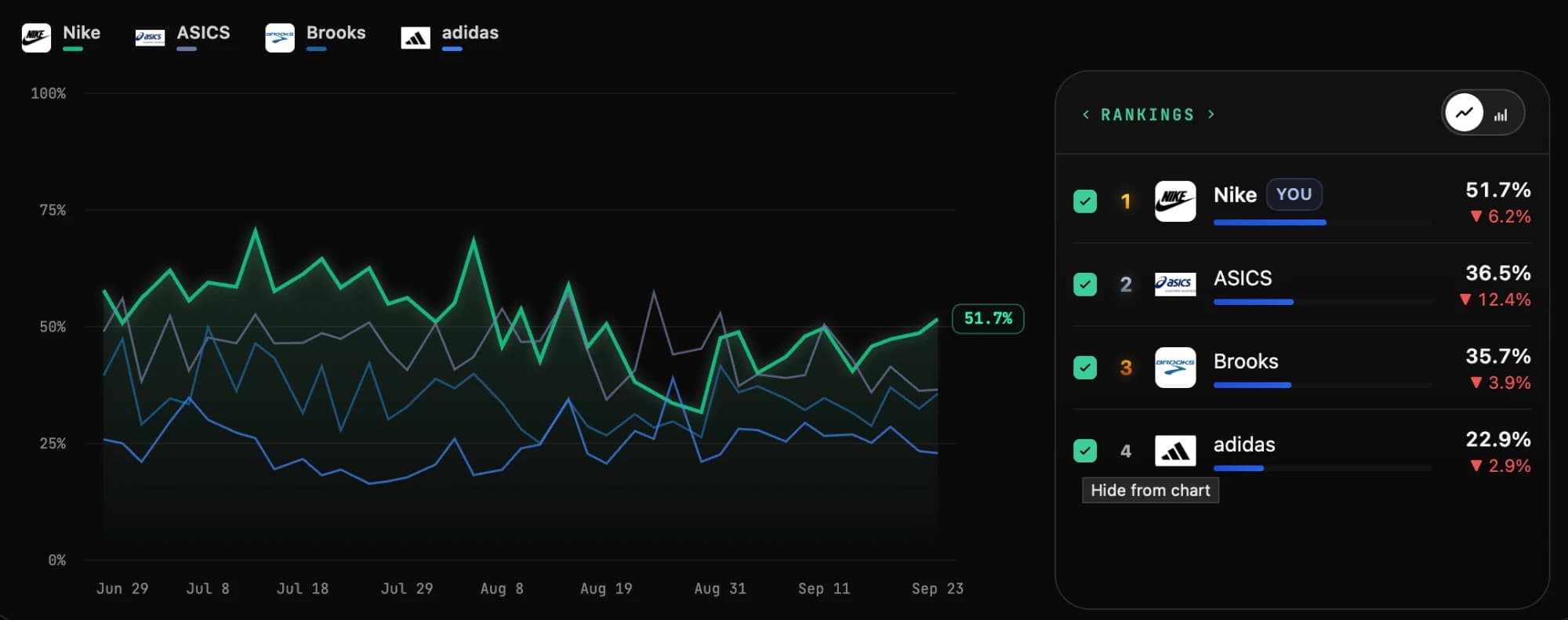
The aggregate score is useful for reporting. The metrics underneath it explain why the score changed.
What do mention counts tell you?
Mentions are the simplest underlying signal.
For a given set of tracked responses, you can ask: how many times was our brand mentioned? Or, more usefully: in what percentage of relevant answers did our brand appear?
Mentions help separate two possible reasons for an AI Visibility change.
Your visibility might increase because your brand started appearing in more answers. Or your mention frequency might stay relatively stable while your average position improves.
Without the underlying mention data, those two changes can look the same at the top level.
Mentions are particularly useful when comparing brands across the same set of prompts.
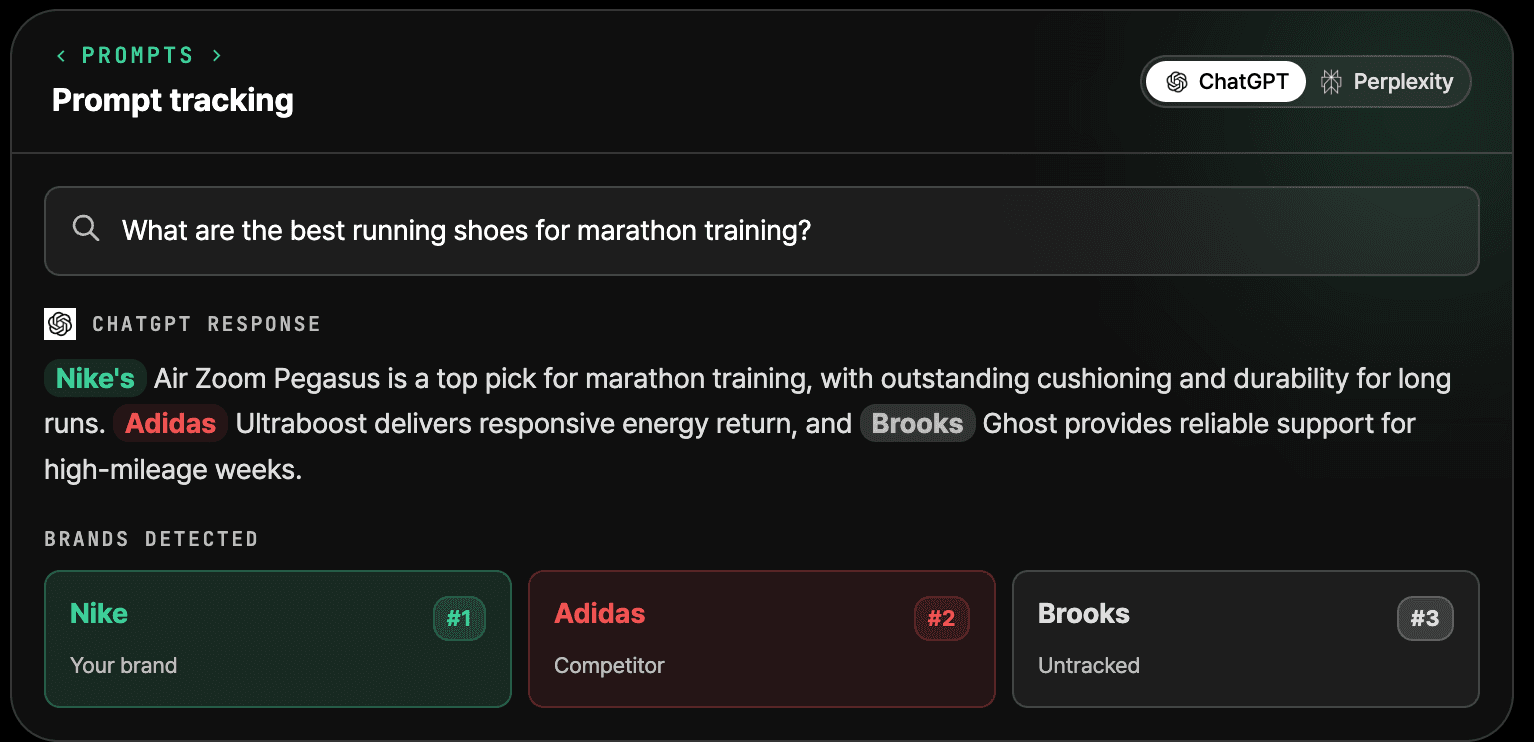
Why does position matter as much as being mentioned?
Being included matters. Where you appear matters too.
Consider an answer to:
"What are the best CRM platforms for a small business?"
One brand might be introduced first. Another might appear seventh in a long list.
Both receive a mention, but they do not have the same prominence.
Position helps capture this difference.
This should not be interpreted exactly like a Google ranking. AI-generated answers have far less standardized structures.
An answer may contain:
- a numbered list
- a comparison table
- several brands inside paragraphs
- separate recommendations for different use cases
Position is therefore most useful when you can inspect the complete answer behind the metric.
The metric tells you where you appeared. The response tells you why that position matters.
How do prompt tags reveal where visibility changes?
A single overall visibility number can hide large differences between topics.
This is where prompt tags become useful.
You might tag prompts by:
- product category
- use case
- customer type
- comparison prompts
- buying-stage questions
- geography
- another topic relevant to the business
Suppose your overall AI Visibility is relatively stable, but tagged prompts reveal:
| Prompt tag | AI Visibility |
|---|---|
| General category | 68 |
| Product comparisons | 47 |
| Enterprise use cases | 31 |
| Small-business use cases | 72 |
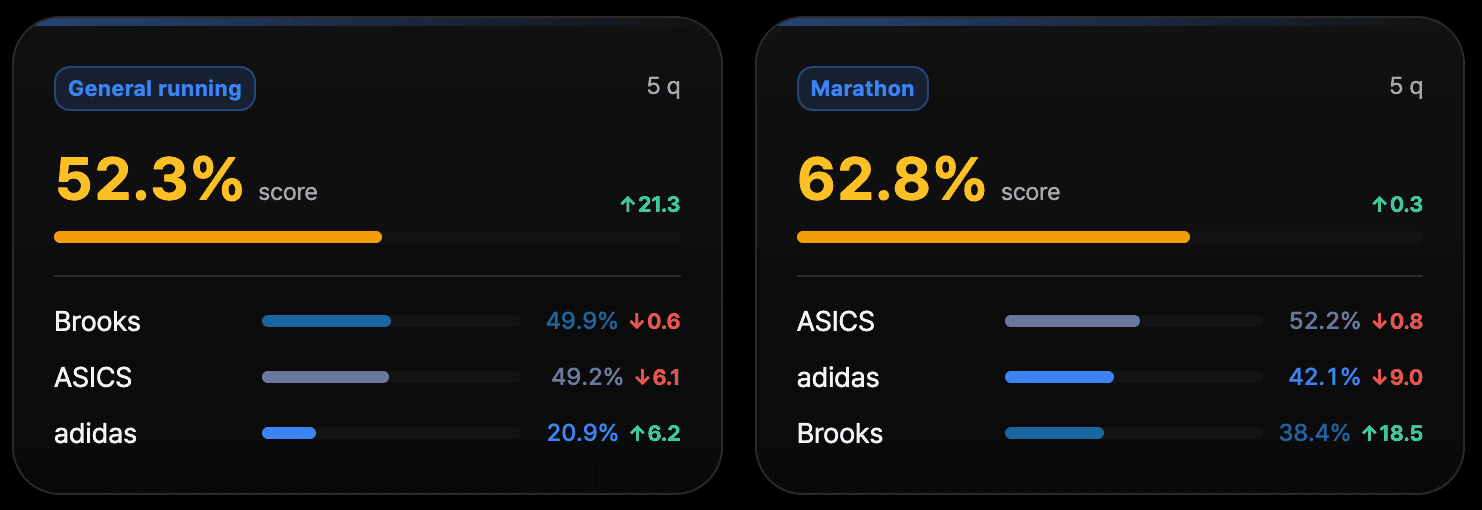
The aggregate result tells you how the brand is performing overall.
The tags show where the gaps are.
This makes the data much easier to act on. Instead of deciding that "we need more AI visibility", you can see which parts of the prompt set need investigation.
Why track competitor visibility, not just your own?
AI search measurement makes more sense in a competitive context.
If your visibility falls, that is useful information. But the next question should be: which brands gained visibility instead?
Tracking competitors across the same prompts helps identify:
- which competitors appear most frequently
- which brands tend to occupy higher positions
- where a competitor performs particularly well
- topics where your brand is absent but competitors consistently appear
- whether competitive visibility differs by engine
This analysis is more useful than treating the entire market as one share-of-voice percentage.
You retain the underlying information: which competitor appears, for which prompt, on which engine and in what position.
That makes it possible to investigate the answers themselves rather than stopping at an aggregate competitive score.
What do citations tell you that mentions do not?
Brand mentions tell you who appears. Citations help explain where the information behind the answer is coming from.
A brand can be mentioned without its website being cited. An AI engine might instead rely on publishers, review sites, forums, documentation, product pages or other third-party sources.
So citation analysis should look beyond whether your own domain received a citation. The reverse pattern is just as common: your domain gets cited as a source while the generated answer never actually names your brand – we've covered that specific gap separately.
Useful things to measure include:
- most frequently cited domains
- most frequently cited URLs
- your own cited pages
- competitor domains and pages
- sources that appear repeatedly for specific topics
- citation differences between AI engines
- sources associated with prompts where competitors outperform you
This creates a practical link between AI visibility measurement and content or digital PR work.
If the same third-party page repeatedly appears behind answers where a competitor is recommended or prominently mentioned, that source deserves investigation.
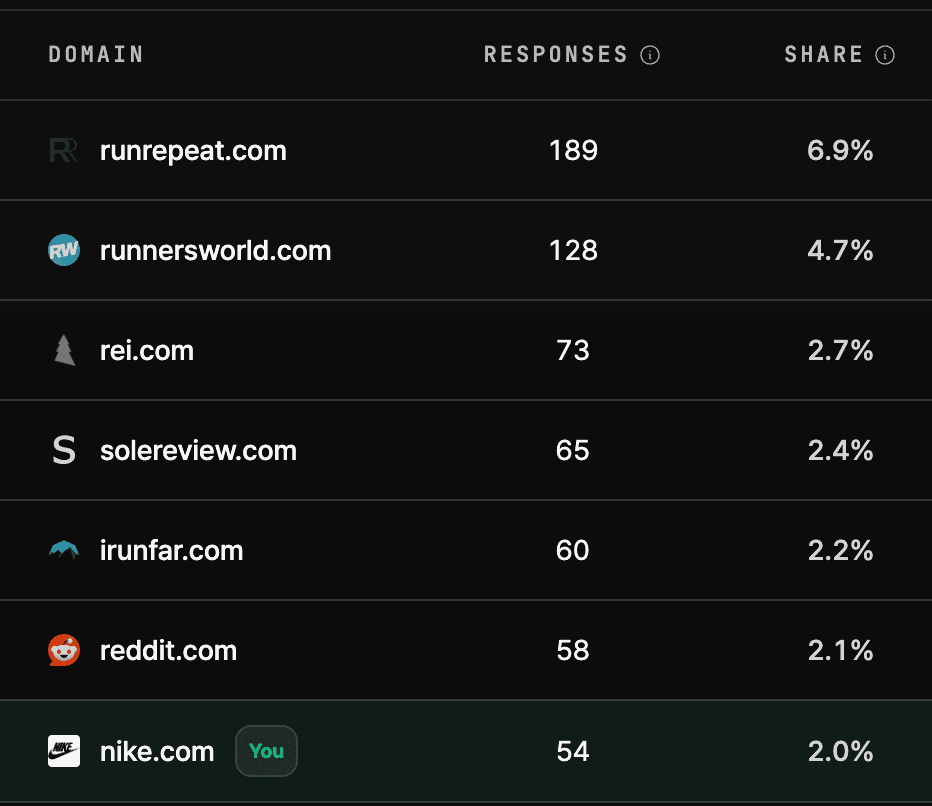
Citations are therefore less useful as a single KPI and more useful as a diagnostic layer.
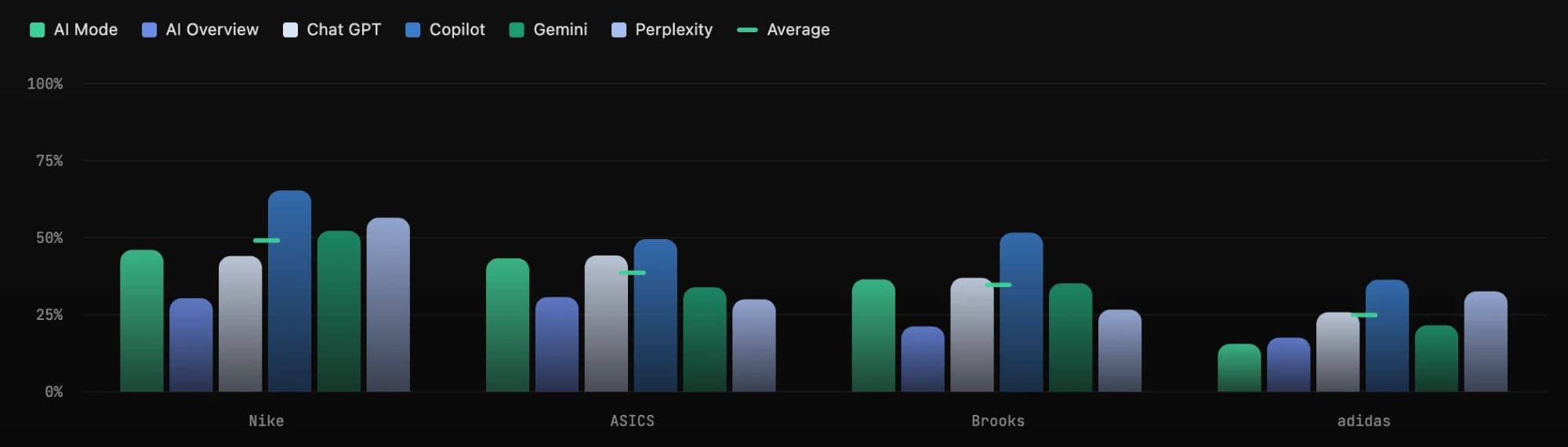
Why should you compare AI engines separately?
There is no single AI search result.
The same prompt can produce a different answer depending on whether it is run through ChatGPT, Gemini, Perplexity, Google AI Overviews or Google AI Mode.
A hypothetical brand might see:
| Engine | AI Visibility |
|---|---|
| ChatGPT | 71 |
| Perplexity | 63 |
| Gemini | 55 |
| Google AI Mode | 39 |
| Google AI Overviews | 28 |
An average across every engine is useful for a quick overview, but it hides most of the interesting information.
The gap between ChatGPT and Google AI Overviews may point to differences in:
- which sources the engines retrieve
- how they construct recommendations
- which types of pages they rely on
- how many brands they include in an answer
This is why the same prompts should be compared engine by engine.
Why track these metrics over time rather than once?
AI visibility should be measured as a trend rather than through isolated checks.
AI-generated answers can change between repeated runs of the same prompt. Model updates, retrieval results and other parts of the system can all affect what appears.
That makes a one-off manual test a weak basis for measurement.
If your brand appears once for a prompt, that tells you what happened in that particular answer. It does not establish that your brand consistently appears for that topic.
Scheduled prompt tracking gives you a better view.
Look for changes that persist across multiple runs:
- AI Visibility moving up or down
- mention frequency changing
- average position changing
- a competitor beginning to appear repeatedly
- different domains becoming common citation sources
The trend matters more than the individual response.
What should you measure outside the AI answer itself?
AI visibility platforms measure what happens inside AI-generated answers.
Your normal analytics stack should cover what happens after someone clicks through to your website.
Depending on your setup, that may include:
- sessions from identifiable AI referrers
- engaged sessions
- leads
- sign-ups
- assisted conversions
- revenue
Vercite does not measure these metrics. They belong in tools such as your web analytics and attribution platforms.
They are still worth including in an AI search measurement framework because they answer a different question.
Vercite can tell you whether your brand is appearing, where it appears and which sources are being cited. Analytics can tell you about the measurable traffic and actions that follow.
The two datasets should not be confused.
Ask customers how they found you
Referral data will miss some AI-influenced journeys.
A user might discover your brand in ChatGPT, search for your company name later, visit directly, or convert through another channel. In analytics, that journey may look like organic search, direct traffic or something else entirely.
A simple way to capture some of that hidden influence is to ask new customers or leads: "How did you first hear about us?"
Include options such as:
- ChatGPT or another AI assistant
- Social media
- Recommendation from someone
- Podcast, article or newsletter
- Other
For businesses with lower lead volumes, an open-text field can be even more useful because people may answer with specifics such as "ChatGPT", "Perplexity" or "Google AI Overview".
This is not precise attribution. People forget, simplify journeys and often encounter a brand more than once.
But it adds a useful signal that click-based analytics cannot capture.
If AI starts appearing regularly in those responses while your measured AI visibility is also improving, that is a much stronger indicator than referral traffic alone.
A large part of an AI interaction can happen without a click. Someone may discover a company, compare it with alternatives and remember the recommendation without ever visiting the cited source.
Referral traffic therefore measures one outcome of AI visibility, rather than AI visibility itself.
What does a practical AI search measurement framework look like?
You do not need dozens of numbers on the main dashboard.
Start with AI Visibility as the top-level metric. Then use the underlying measurements to explain it:
AI Visibility
Is the brand becoming more or less visible across the prompts that matter?
Mentions and position
Is the change coming from appearing more often, appearing more prominently, or both?
Prompt tags
Which categories, use cases or types of questions are responsible for the change?
Competitors
Which brands are gaining or losing visibility across those same prompts?
Citations
Which pages and domains are repeatedly supplying information to the engines?
Engines
Does the pattern hold across ChatGPT, Gemini, Perplexity and Google, or is it isolated to one system?
Business outcomes
What traffic and conversions can your existing analytics attribute to AI platforms? And are customers themselves reporting AI assistants as a discovery source?
This gives you a path from a high-level KPI to the actual responses, prompts and sources responsible for it.
The short version
Counting mentions is useful, but it is only one part of measuring AI search.
A brand mentioned first and a brand mentioned eighth should not necessarily be treated equally. Neither should strong performance on ChatGPT obscure weak visibility on another important engine.
Start with AI Visibility. Then break the number apart.
Look at mentions and position. Segment the prompts with tags. Compare competitors and engines. Investigate the citations behind the answers. Finally, connect the data with traffic, conversions and customer-reported discovery where your analytics allow it.
That produces a much better picture of how a brand appears in AI search than any individual metric can provide.
Frequently asked questions
What is AI Visibility in AI search measurement?
AI Visibility combines two things: whether your brand appears in the tracked answers, and how prominently it appears when mentioned. Two brands mentioned equally often can have very different visibility if one is usually named first and the other fourth or fifth.
Is mention count the same as AI visibility?
No. Mention count tells you how often a brand appears; position tells you where it appears when it does. A rising mention count and an improving average position can look identical at the top line, so both need to be tracked separately to know which one moved.
Should you compare AI engines separately or as one average?
Separately. ChatGPT, Gemini, Perplexity, Google AI Overviews and Google AI Mode can retrieve different sources and construct different answers for the same prompt. An average across all of them is useful for a quick overview but hides which engine is actually driving a change.

Builds Vercite and writes most of its research and case studies.
LinkedInAI Brand Mentions: What They Are and How They Differ From Citations
Learn what AI brand mentions are, how they differ from citations, what mention position means, and how to track brand mentions across AI search engines.
BlogThe Types of Citations in AI Answers: What AI Search Actually Cites
AI answers can cite brand websites, media, Reddit, reviews, official sources and more. Learn the main types of AI citations and how to analyze them.
BlogHow to Choose Prompts to Track for AI Visibility
Learn how to find and choose prompts to track for AI visibility using Google Search Console, keyword data, customer pain points, People Also Ask and real buyer questions.
See how AI engines describe your brand
Vercite tracks your mentions, citations and sentiment across ChatGPT, Gemini, Perplexity and Google AI – on a schedule, not a spot check.