Citation gap analysis: find the pages AI cites for rivals, not you
Find the pages ChatGPT, Gemini and Google AI cite for your competitors but not you, rank them, and turn each gap into a concrete action.
Published October 15, 2026 · 9 min readA citation gap is a page AI already uses for the prompts you care about, but where your brand is missing.
If that page mentions two competitors and gets cited repeatedly across commercial prompts, you have found something more useful than a generic list of websites to pitch. You know the page is already entering the answers you want to influence.
The method is straightforward: track the sources each engine cites, identify pages where competitors appear and you do not, rank the gaps by impact, then decide what action makes sense for each page.
Do it per engine. And repeat it.
Citation sets move too quickly for a one-off audit to stay useful.
What is a citation gap?
A citation gap is a cited page where your brand is absent even though the page is relevant to prompts where you want visibility.
There are two useful versions.
The first is a competitor gap: an AI engine cites a page that mentions one or more competitors but does not mention your brand.
The second is a category gap: the page is frequently cited for your prompts, but none of the brands you track appear on it yet.
Both can create an opportunity.
A competitor gap may point towards outreach, a directory listing, a partner profile or coverage you are missing.
A category gap may reveal that the page itself answers the need without naming vendors. In that case, the right action could be creating a stronger resource on your own site rather than trying to force your brand into somebody else's article.
This is also why AI citations need to be separated into different types. A citation tells you which source surfaced around an answer. It does not prove that the page directly caused a particular brand mention.
Why do third-party pages matter so much?
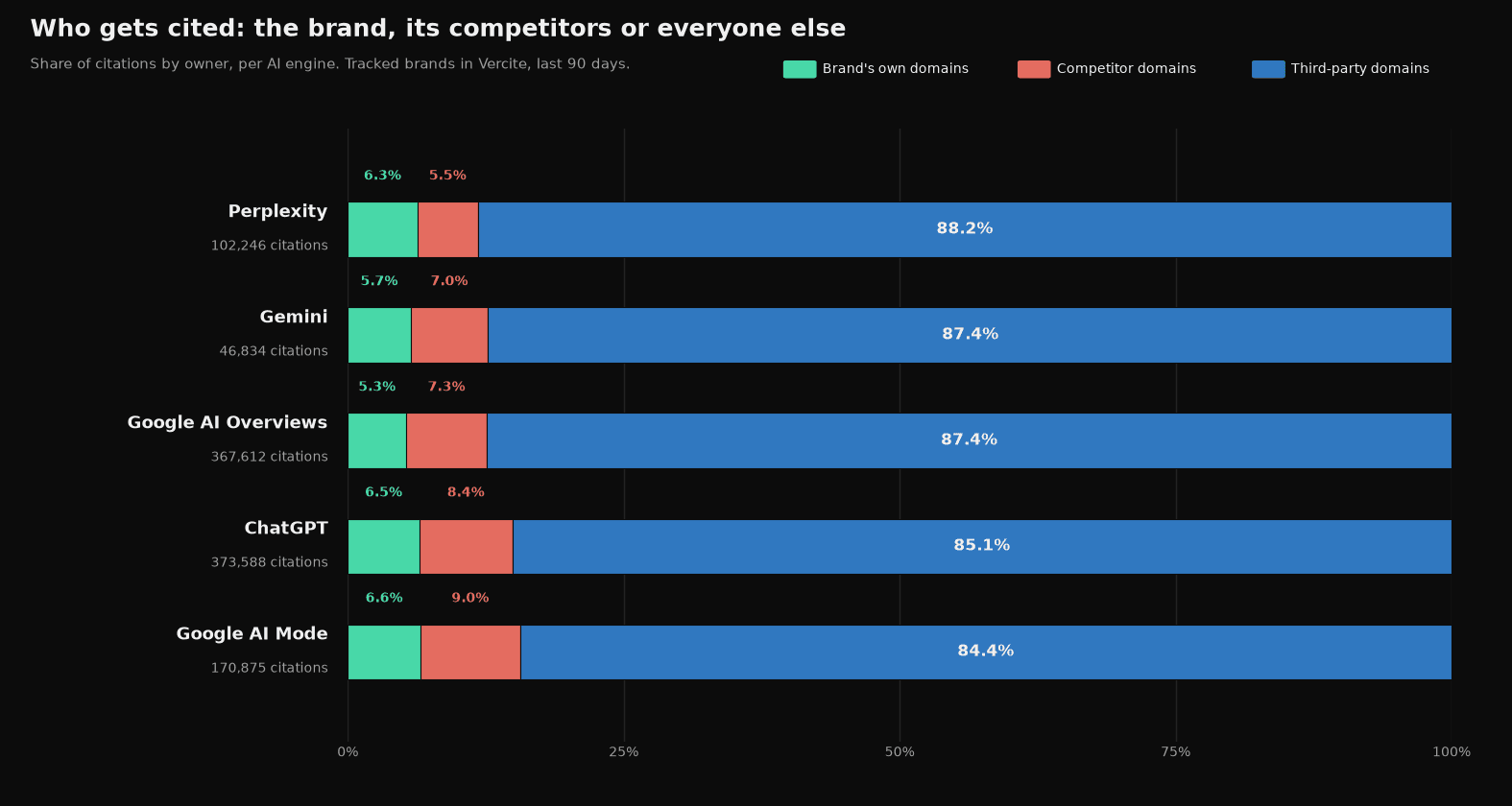
Third-party pages matter because commercial prompts often push AI engines towards sources that compare several options rather than pages controlled by one brand.
The scale depends heavily on the engine, category and prompt type.
A small August 2026 study by The HOTH looked at ChatGPT citations for four brands in the US. When the prompts named the brand, 69.6% of citing responses pointed to the brand's own domain. For prompts containing "best", that fell to 1.3%. The sample is too limited to treat those percentages as universal, but the direction is useful: recommendation-style prompts produced a very different source set.
That is where citation gaps often live.
Your website may already answer questions about your own product well. Yet the pages shaping comparison prompts can belong to publishers, directories, review sites, forums, partners and other third parties.
This also explains the cited-but-not-mentioned problem. Your own content can surface as a source while the answer still names a competitor, or a third-party page can be cited repeatedly while mentioning everyone except you.
How do you run a citation gap analysis?
Run a citation gap analysis by fixing the prompts and competitors first, then collecting and ranking the cited pages that repeatedly appear around them.
1. Fix the prompts and competitors you want to measure
Your source data is only as useful as the prompts behind it.
Choose questions that represent real customer needs, product comparisons and category decisions. Do not rebuild the set halfway through the analysis because the first results look strange.
Our guides to choosing prompts and deciding how many prompts to track go deeper on this.
Also define the competitors you care about.
The goal is not to monitor every brand an engine might ever mention. Pick the companies customers would genuinely compare with you.
2. Collect cited URLs per prompt and engine
Capture the URLs each engine cites for the same prompts over several runs.
One run is weak evidence.
AI-generated answers vary, and the source set can change even when the prompt does not. Repeated runs help separate a recurring source from something that happened once.
Keep the engines separate.
3. Group the sources by type
Classify the domains into useful working groups, such as:
- your own properties
- competitor-owned properties
- media and editorial publishers
- review sites and directories
- forums and communities
- video platforms
- partner and marketplace pages
The classification is not the goal by itself.
It helps decide what you can realistically do next.
4. Flag pages where competitors appear and you do not
Now inspect the pages that recur.
Does the page mention Competitor A and Competitor B but not you?
Does it describe the category but contain no relevant brands?
Does it list your company but use old information?
Each creates a different task.
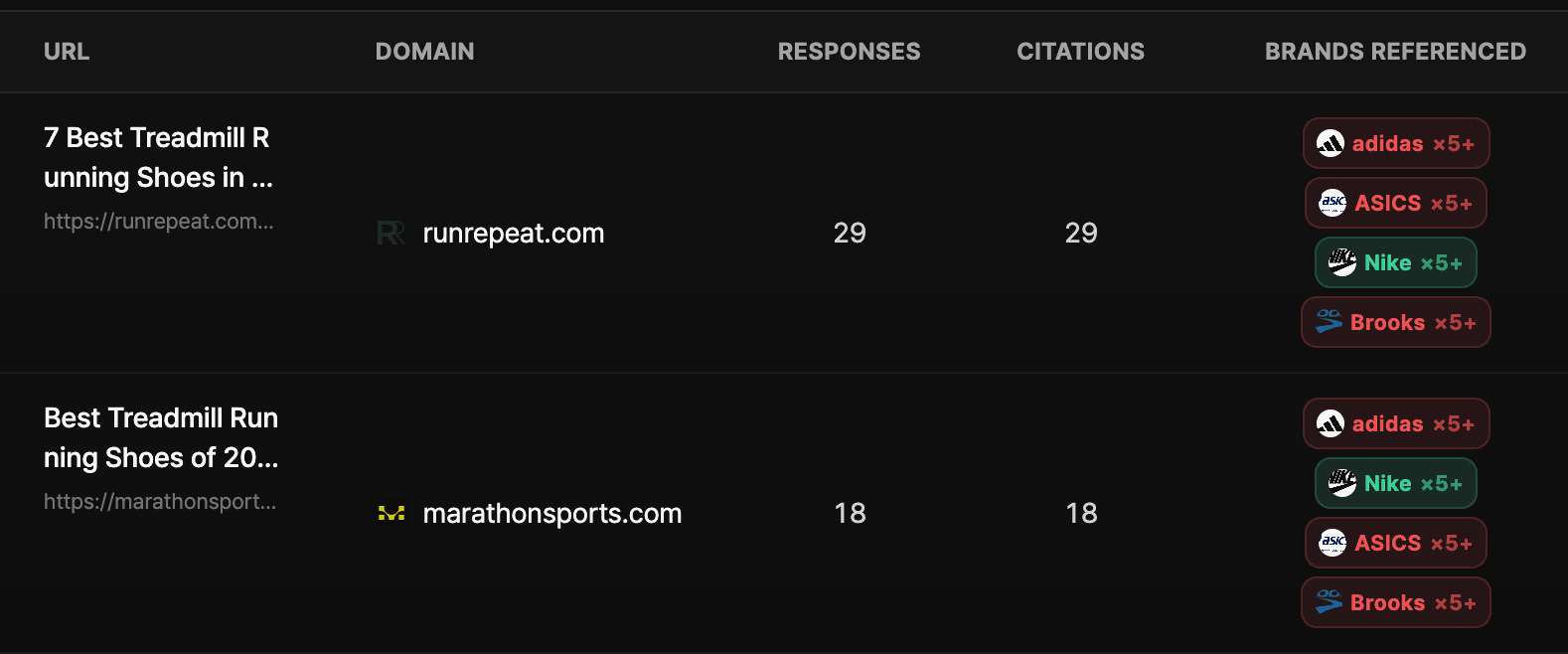
Vercite's citation analysis can show the cited pages behind tracked responses and which brands those pages contain. That reduces the manual part of finding the gaps, while the decision about what to do with each page still belongs to you.
5. Rank the gaps
Do not turn every missing mention into a task.
Rank pages using three questions:
- How often is this page cited?
- Across how many important prompts does it appear?
- How relevant is the page to the decisions we want to influence?
A niche article cited repeatedly across ten commercial prompts may deserve more attention than a famous publisher that appeared once.
6. Pick one action per page
The action should follow the type of gap.
Some pages are realistic outreach targets. Others should be ignored.
The next section gives a practical way to separate them.
7. Re-check the list monthly
Citation gaps are not permanent.
SISTRIX analysed 82,619 prompts across 17 weeks and found that 56% of AI Mode sources and 74% of ChatGPT Search sources changed from one week to the next at domain level. The exact churn differed by platform and market, but the broader point is clear: source sets can move quickly.
A gap analysis from six months ago can therefore become a poor task list.
Refresh it.
What should you do with each citation gap?
The right action depends on who owns the page and why it is being cited.
| Page type | What to do | Example |
|---|---|---|
| Review site or directory | Claim, complete or correct the listing where legitimate | Add missing services, facts or categories |
| Editorial roundup | Pitch the publisher with useful evidence for inclusion or an update | New product data, market data or a factual correction |
| Competitor-owned comparison | Usually leave it alone | Build a useful neutral resource on a topic you can own instead |
| Forum or community thread | Participate genuinely and disclose who you are | Answer the underlying question as a named employee |
| Relevant page with no brands | Consider creating a better first-party resource | A clear guide, dataset, documentation page or decision resource |
| Existing profile with wrong facts | Correct the source | Update pricing, location, product availability or other factual data |
External pages can matter enough to justify real work.
A recent SIXT experiment is a useful example. SIXT changed content across external partner listings rather than its own website. Across the two full-treatment domains, citation frequency increased by 320%, or about 308% after adjusting for movement in the control. The experiment covered one company and a small number of domains, so it should be treated as evidence worth testing rather than a guaranteed playbook. (Peec)
The lesson is narrower than "edit third-party pages and citations rise".
It shows that pages you do not own can be valid surfaces for AI-search work when they already sit inside the source environment around your prompts.
Should you publish your own "best of" list?
Publishing a self-promotional "best of" list is a tactic to approach cautiously, because the evidence is mixed and the risk depends on both the content and the brand.
Lily Ray analysed 100 B2B software "best" prompts in Google AI Overviews across three checkpoints in 2026. In 224 of 323 cases where Google cited a self-promotional listicle, the brand that published the page was not included in the recommendation. That works out to roughly 69%. (Search Engine Land)
A citation is not the same thing as brand inclusion.
Google also updated its spam-policy language in May 2026 to explicitly cover attempts to manipulate generative AI responses in Google Search. (Search Engine Land)
But that does not mean every vendor-authored comparison page has been removed from search or AI citations.
Kevin Indig's analysis of 5.32 million Google results found no universal penalty for listicles, and cited Peec data showing no clear demotion of self-promoting listicles across AI citation datasets. His own Google analysis found a smaller decline in listicles at the top of search results, but could not attribute that specifically to self-promotional pages. (Growth Memo)
So the practical recommendation is restraint.
If you have a genuinely useful comparison resource and can support every claim, publish it because it helps the reader. Do not manufacture hundreds of "best" pages purely to insert yourself at number one.
For regulated industries such as finance, pensions and health, skip self-published competitor rankings entirely. Use factual first-party content and independent third-party coverage instead.
Why should citation gap analysis be run separately for each engine?
Citation gap analysis should be engine-specific because the source patterns can differ enough that a blended list hides the useful part.
One recent B2B SaaS dataset illustrates how quickly that can change even inside a single engine.
Discovered Labs analysed 291,607 ChatGPT citations from buyer-intent prompts between October 2025 and August 2026. Documentation pages increased from 36.9% to 55.1% of citations, while listicles fell from 6.0% to 1.0%. The authors explicitly caution that this is their B2B SaaS prompt set, not a universal picture of ChatGPT.
SISTRIX found another type of divergence. In its 17-week sample, AI Overviews were relatively stable for many prompts, while AI Mode replaced around 56% of source domains per week and ChatGPT Search replaced considerably more.
That means a strong citation target in ChatGPT may barely matter in Google AI Mode.
Do not average that distinction away.
Run the same process for each engine, then look for overlap afterwards.
How does Vercite help with citation gap analysis?
Vercite gives you the response and source data needed to build the gap list without manually repeating every prompt yourself.
For each tracked prompt, you can inspect the cited pages and domains behind the response, compare engines and see which tracked brands appear on cited pages.
That gives you a workflow:
- Find the prompts where competitors appear and you do not.
- Inspect the sources cited around those answers.
- Find recurring pages where competitors are present but your brand is absent.
- Prioritise the pages that recur across important prompts.
- Make the appropriate content, outreach or profile change.
- Keep tracking the same prompts and sources to see what changes.
It does not tell you that a particular citation caused a particular mention.
No citation tracker can establish that cleanly from the outside.
The useful output is a prioritised list of pages already sitting inside the source environment around the answers you care about.
That is a much better starting point than guessing which websites AI might trust.

Builds Vercite and writes most of its research and case studies.
LinkedInThe Types of Citations in AI Answers: What AI Search Actually Cites
AI answers can cite brand websites, media, Reddit, reviews, official sources and more. Learn the main types of AI citations and how to analyze them.
BlogWhy Your Domain Gets Cited in AI Answers but Your Brand Doesn't
Your website can be cited by ChatGPT, Gemini or Perplexity without your brand appearing in the answer. Learn why it happens and how to increase brand mentions in AI answers.
ResearchDo AI search engines cite the same websites?
Across 5.31 million citations, the five major AI engines agree on only 9% of their most-cited domains. We classified 158,847 domains by source type and publisher.
See how AI engines describe your brand
Vercite tracks your mentions, citations and sentiment across ChatGPT, Gemini, Perplexity and Google AI – on a schedule, not a spot check.