ChatGPT Business Hub: what it measures and what it leaves out
ChatGPT Business Hub shows mentions, clicks and discovery topics for your website. Here's what those numbers mean, what they miss, and how to fill the gaps.
Published November 11, 2026 · 7 min readChatGPT Business Hub gives businesses something AI search has largely lacked: first-party visibility data directly from the platform.
Once verified, you can see how often ChatGPT references your business, how many recorded clicks go to your website and the broad topics where you appear. You can also update information about your business and, where eligible, connect product data.
Claim it.
But Business Hub is not a replacement for prompt tracking. It measures aggregate activity around your own business inside ChatGPT. It does not show the prompts behind those numbers, which competitors appeared alongside you, what other sources shaped the answer or how you perform in Gemini, Perplexity or Google's AI experiences.
The two answer different questions.
What is ChatGPT Business Hub?
ChatGPT Business Hub is OpenAI's dashboard for businesses to claim their presence in ChatGPT, manage their information and see aggregated engagement data.
OpenAI launched Businesses in ChatGPT in beta on 10 November 2026. After a claim and identity verification, businesses can update information, connect a product feed where relevant and access insights such as mentions and website clicks.
Business Agents are a separate feature. They let customers interact directly with a business through a clearly labelled agent, but they are currently limited to eligible ecommerce and online-service businesses in the US. (OpenAI)
For everyone else, the more immediately useful part of Business Hub is the profile and the data.
What does ChatGPT Business Hub measure?
Business Hub currently measures mentions, website clicks and discovery topics, with profile views also appearing in the current interface.
The dashboard offers 7-day and 28-day views. The figures are aggregated, and OpenAI only shows data once enough activity exists to meet its privacy thresholds. A blank metric therefore does not necessarily mean zero.
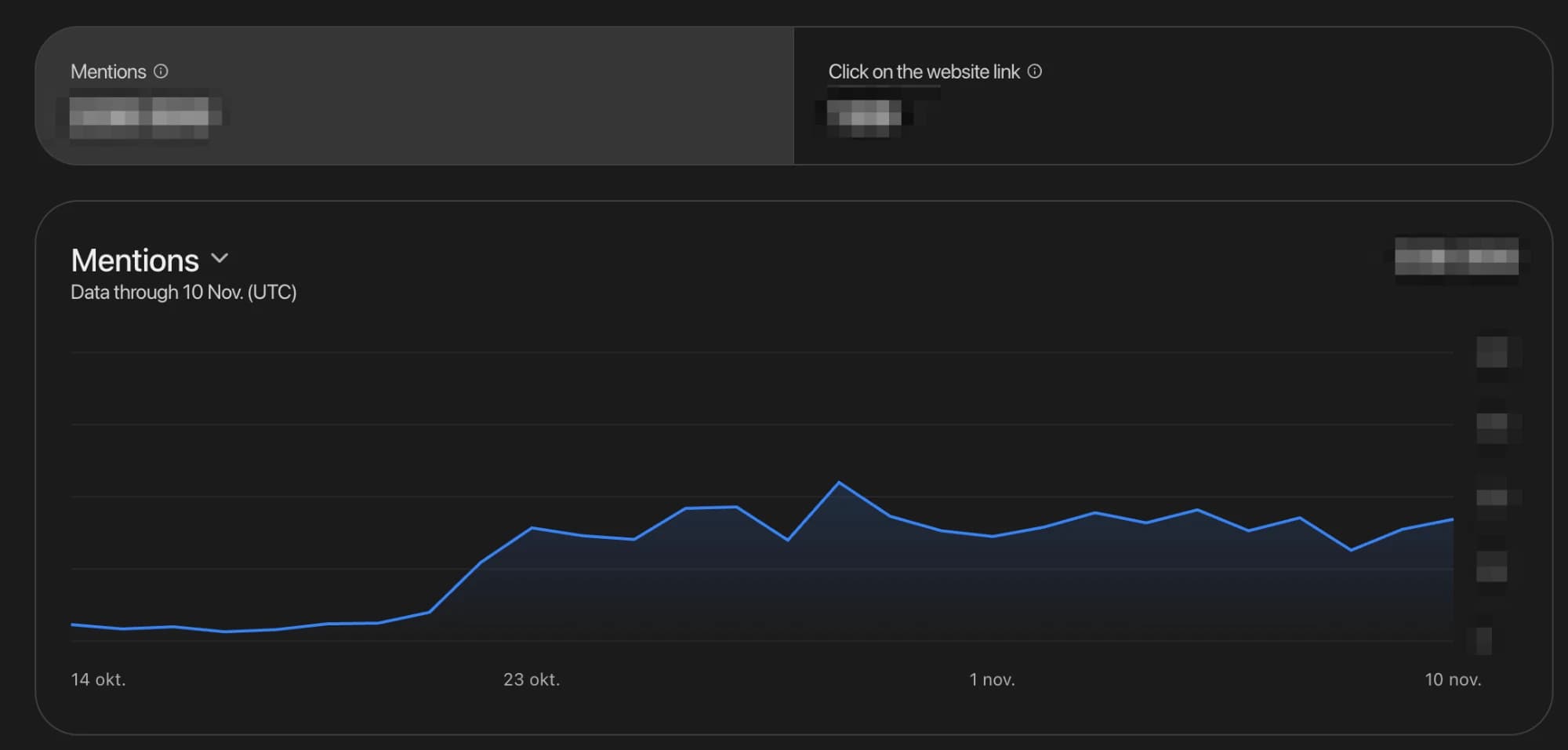
The definitions matter.
Mentions
For an online business, a mention is counted when ChatGPT references the business's website.
If ChatGPT writes your brand name but does not reference your site, that alone does not count as a Business Hub mention. (OpenAI help)
That is different from the way we define an AI brand mention, where the brand being explicitly named in the generated answer is the event being measured.
Website clicks
A website click is a recorded click on a link to your site from ChatGPT.
OpenAI explicitly warns that this does not confirm a website visit or conversion. Browser behaviour, redirects, analytics blocking and the user's next action all sit outside that number.
Discovery topics
Discovery topics group the broad themes in conversations where your business appears or your website is cited.
They are not the individual prompts users typed. Businesses do not get access to people's conversations. (OpenAI)
Think of them as directional categories rather than a search-term report.
How do you claim your business in ChatGPT?
You claim a business by finding it in Business Hub, proving that you are authorised to manage it and completing OpenAI's verification process.
The current flow is:
- Open Business Hub from ChatGPT on the web and search for your business.
- Select the matching listing and start the claim.
- Complete one of the verification methods offered to you, such as business phone, business email, a DNS record or Shopify.
- Wait for OpenAI to review the claim.
- Once approved, complete identity verification through Persona before publishing changes or viewing insights.
OpenAI says eligible businesses where ChatGPT is available can claim, but eligibility also depends on factors such as business type, location and whether the required verification is supported. Local stores and restaurants currently have narrower US-specific restrictions.
So for a Swedish business, there is no blanket rule that says "Sweden is unavailable". The practical test is whether your business appears in Business Hub and the required verification route is offered.
What doesn't Business Hub tell you?
Business Hub shows what happened around your business in aggregate. A prompt tracker lets you investigate the individual answers behind AI visibility.
| Question | ChatGPT Business Hub | Vercite |
|---|---|---|
| How often did ChatGPT reference my website? | Yes | Can measure mentions and citations on tracked prompts |
| Which prompts triggered my visibility? | No | Yes, for the prompts you track |
| Was my brand named without my website being cited? | No | Yes |
| Which competitors appeared in the same answer? | No | Yes |
| Which other pages and domains were cited? | No | Yes |
| How was my brand described? | No | Yes |
| What happens in other AI engines? | No | Yes |
| Can I compare more than 28 days of history? | Not in the current Hub view | Yes |
The distinction is useful.
Business Hub gives you first-party aggregate data from real ChatGPT usage. Prompt tracking gives you controlled measurement on a fixed set of questions.
Neither dataset is a substitute for the other.
How do Business Hub and a prompt tracker work together?
The most useful workflow is to use Business Hub for discovery and first-party measurement, then prompt tracking to investigate the answers in detail.
- Claim the business and correct the facts you control. Check your business information, website, category and other profile data.
- Use discovery topics as input for prompt research. If a topic repeatedly appears in Business Hub, turn it into actual questions worth monitoring. Our guide to choosing prompts to track covers where to find those questions and how to avoid building the set around your own brand name.
- Track a stable prompt set. Run those questions repeatedly instead of checking them once. The point is to see which brands appear, what sources are cited and how the answer changes over time. You do not need hundreds of prompts to get started.
- Compare the trends monthly. Business Hub can tell you whether aggregate ChatGPT activity moved. Prompt tracking can help show which topics, competitors, answers or sources changed inside your measured set.
- Compare clicks with your own analytics. GA4 now separates recognized AI assistant referrals into an AI Assistant default channel group. It is useful for traffic that arrives with a detectable referrer, but it remains a lower-bound view of AI-driven discovery because not every brand exposure becomes a click. (Search Engine Journal)
This gives you three different layers: what ChatGPT reports, what controlled prompt monitoring observes and what reaches your website.
Why won't Business Hub and prompt tracking show the same numbers?
The numbers will differ because Business Hub and prompt tracking count different events from different populations.
Business Hub observes real ChatGPT activity involving your business across a large, uncontrolled set of conversations.
Prompt tracking starts from a fixed set of questions chosen by you and runs them repeatedly. In Vercite, that means measuring whether the brand appears in the response, where it appears, which competitors are present and which sources are cited.
There is another important definition difference.
For an online business, Business Hub counts a mention when ChatGPT references the website. Vercite counts a brand mention when the brand name appears in the generated answer.
Imagine ChatGPT names your company after relying on an independent review site but never references your own domain.
That can be a brand mention in prompt tracking without being a Business Hub website mention.
The reverse can happen too: your site may be used as a source without your brand receiving meaningful exposure in the final answer. We have a separate guide to the cited-but-not-mentioned pattern.
So do not try to reconcile both tools into one number.
Use the difference to understand what each one is measuring.
What else should you know about ChatGPT Business Hub?
Is ChatGPT Business Hub free?
Claiming and managing a business is currently offered through OpenAI's Business Hub without a separate Business Hub subscription being listed.
The product is still in beta, so availability and packaging can change.
Does claiming my business increase my visibility in ChatGPT?
No guarantee comes with claiming a business.
OpenAI says claiming lets you keep information current and gives your profile a verified status, but ChatGPT continues to make its own recommendations and comparisons. Claiming does not guarantee higher placement or sales. (OpenAI)
Can I see which competitors appeared with me?
No.
Business Hub does not currently provide a competitor report or the individual prompts and answers behind its aggregate metrics.
To answer that question, you need to monitor a defined prompt set and inspect which brands occur in the same responses.
Business Hub is worth setting up because it gives you a dataset nobody outside OpenAI can reproduce: aggregate activity from real ChatGPT usage.
Then use it alongside the other side of the measurement problem.
Vercite runs a fixed set of prompts repeatedly and keeps the full answers, brand mentions, competitors and citations behind them. That gives you the context Business Hub intentionally leaves out.
Start with a free trial and build a baseline for the prompts that matter to your brand.

Builds Vercite and writes most of its research and case studies.
LinkedInAI Brand Mentions: What They Are and How They Differ From Citations
Learn what AI brand mentions are, how they differ from citations, what mention position means, and how to track brand mentions across AI search engines.
BlogHow to Choose Prompts to Track for AI Visibility
Learn how to find and choose prompts to track for AI visibility using Google Search Console, keyword data, customer pain points, People Also Ask and real buyer questions.
BlogWhy Your Domain Gets Cited in AI Answers but Your Brand Doesn't
Your website can be cited by ChatGPT, Gemini or Perplexity without your brand appearing in the answer. Learn why it happens and how to increase brand mentions in AI answers.
See how AI engines describe your brand
Vercite tracks your mentions, citations and sentiment across ChatGPT, Gemini, Perplexity and Google AI – on a schedule, not a spot check.