What to do when AI gets your brand wrong
ChatGPT, Gemini or Google AI saying something wrong about your brand? Find the error, trace the source and fix it where AI reads it.
Published November 20, 2026 · 8 min readWhen ChatGPT, Gemini or another AI engine gets a fact about your company wrong, fix the information it can read rather than trying to edit the generated answer itself.
Start by recording exactly what was wrong. Then inspect the sources behind the answer, correct inaccurate information on your own site and relevant third-party pages, and keep checking the same prompt until the answer changes.
This matters for more than visibility.
A brand can appear in every answer and still have a problem if the answer says you sell a discontinued product, operate in a country you left two years ago or charge a price that no longer exists.
Accuracy needs its own monitoring.
Why does AI get facts about brands wrong?
AI engines can get brand facts wrong because the information available to them can be old, inconsistent or ambiguous.
There is rarely one single source of truth behind every generated answer.
An engine may draw on model knowledge, current web retrieval, company websites, directories, publisher articles, reviews and other sources. Different engines can also use different source sets.
Several common failure modes follow.
Your website says one thing while an old directory says another.
A partner page has not been updated since a product changed.
A publisher article still contains last year's pricing.
Two companies have similar names.
A fact changed after the information an engine learned from was produced.
When several public sources disagree, an AI system has to resolve that conflict somehow. It will not always pick the version you consider authoritative.
Which incorrect AI answers matter most?
The most important errors are the ones that can change whether somebody buys from you, contacts you or trusts the information they receive.
| Error type | Example | Risk |
|---|---|---|
| Wrong pricing | AI shows an old monthly price | A customer makes a decision using the wrong cost |
| Discontinued product | AI recommends something you no longer sell | Poor customer experience |
| Wrong service | AI says you offer a service you do not | Irrelevant enquiries |
| Company mix-up | AI confuses you with a similarly named company | Reputation and factual accuracy |
| Old location | AI gives an address you left | Lost visits or support issues |
| Old leadership | AI names a former CEO or executive | Credibility problem |
| Closure claim | AI says the company has closed | High commercial and reputational risk |
Not every wording difference deserves a correction project.
Prioritise objectively wrong facts first.
How do you find AI errors before customers do?
You find errors by tracking factual prompts about your brand, not only non-branded category prompts.
Category prompts tell you whether you are visible when someone is exploring the market.
Fact prompts tell you what AI thinks it knows about you.
For example:
- What does [brand] cost?
- Does [brand] offer [service]?
- Where is [brand] available?
- Is [brand] still operating?
- Who owns [brand]?
- Does [brand] have a free trial?
- Can I use [brand] in Sweden?
Run the questions that could materially affect a customer's decision.
Then read the answers.
A visibility percentage cannot tell you that an engine quoted the wrong price.
If you use Vercite, you do not have to read every answer yourself. Connect the Vercite MCP to your AI assistant, give it the facts that should be true and ask it to compare them with the responses Vercite has tracked.
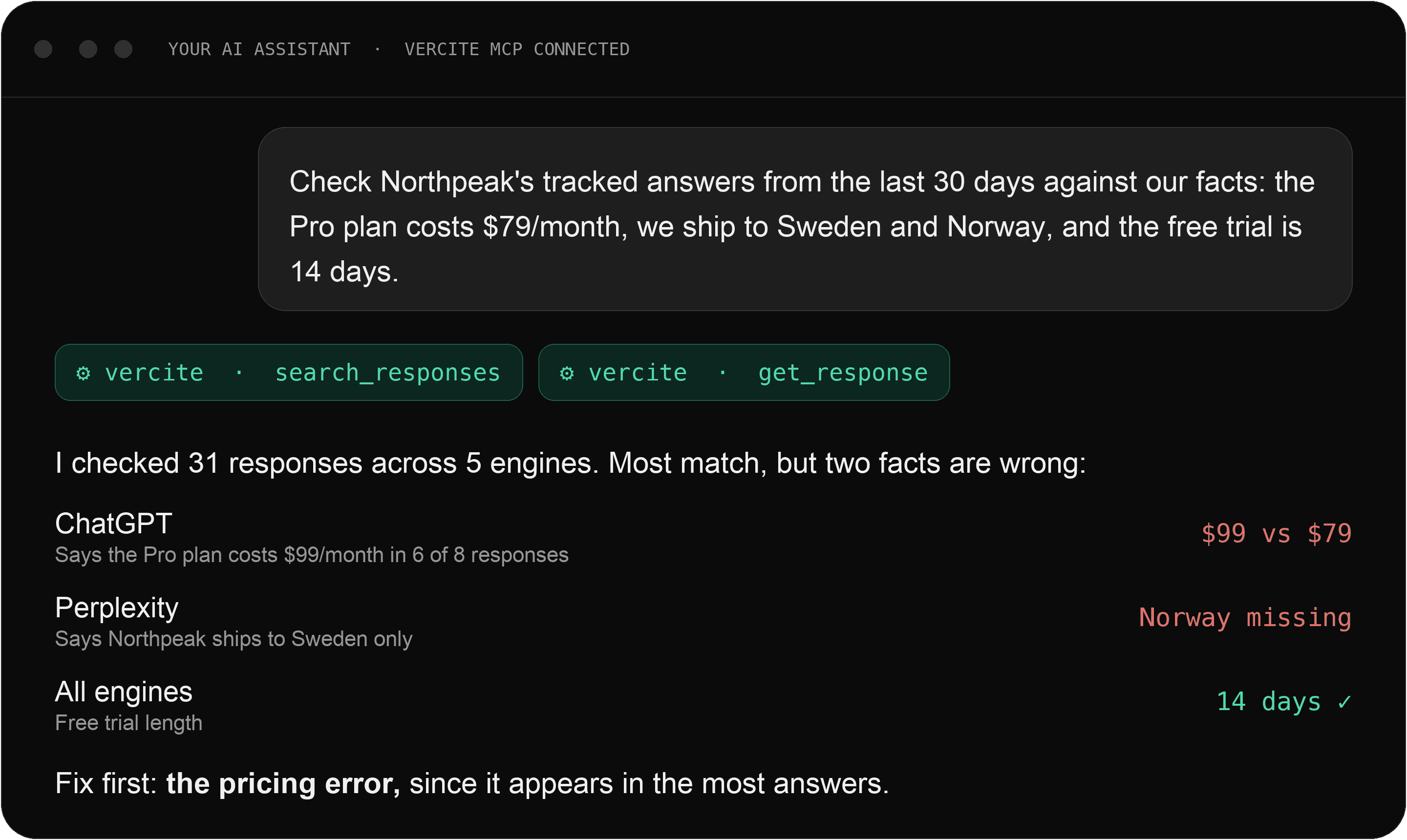
The check is only as good as the facts you give it, so open any answer it flags and read it yourself.
Sentiment can also be a useful triage signal. An unusually negative answer is worth opening and reading even when the underlying issue turns out to be factual rather than subjective. We explain the distinction further in our guide to AI brand sentiment.
Keep the same fact prompts in the set after you make a correction. Otherwise you lose the baseline you need to tell whether anything changed.
How do you trace a wrong AI answer to its source?
Start with the sources the engine shows alongside the incorrect answer.
If the answer says your product costs $99 and one of the cited pages still says $99, you have a concrete correction target.
With the MCP connected you can also ask which pages were cited next to the wrong answer, and what each one says. The error is often on your own site and on third-party pages at the same time.
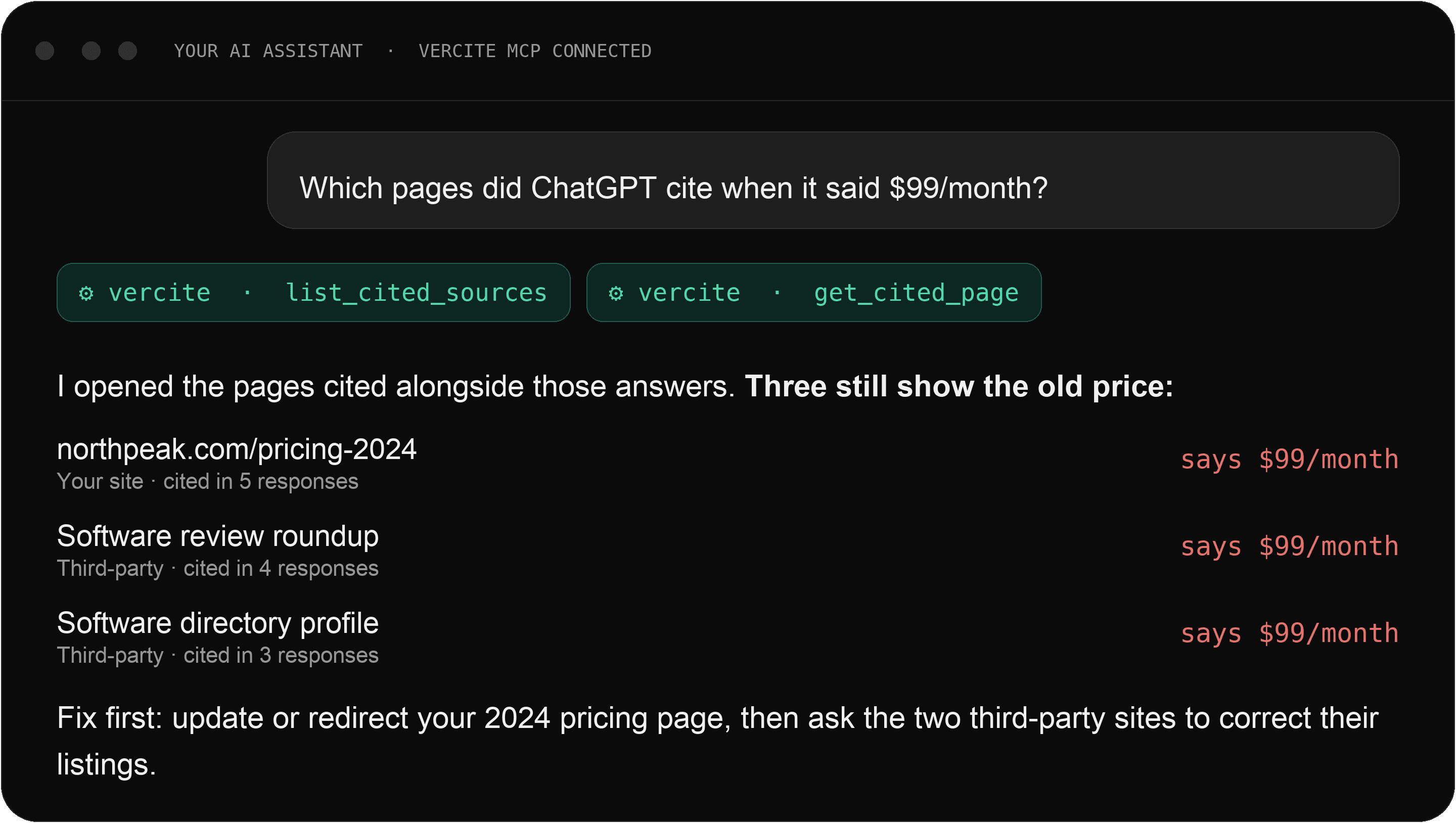
Check the page itself.
Is the wrong fact on your own website?
A partner page?
A directory?
An old article?
A review?
That is the easiest version of the problem because there is a visible source to update.
If none of the cited pages contains the error, the origin is harder to prove. The answer may be drawing on model knowledge, another retrieved source that was not surfaced as a citation, or a combination of several pieces of information.
Do not pretend you can attribute the sentence precisely when the engine does not expose that chain.
Instead, audit the public footprint of the fact.
Search for the old price, address, product name or other wrong information and make the correct version as consistent as possible across the places an engine is likely to read.
This is another reason citations and brand mentions should be measured separately. The source layer can give you clues about an answer without giving you perfect attribution.
How do you fix wrong information in AI answers?
Fix incorrect information in the sources an AI engine can use, starting with the surfaces you control most directly.
1. Correct your own website
Create one clear, current version of the fact.
If pricing is the problem, the pricing page should answer it directly.
If availability is confusing, state where the product or service is available.
If a service was discontinued, remove outdated references rather than leaving contradictory pages live across the site.
Then check the rest of your own domain for conflicting versions.
An authoritative page helps less when three older pages say something different.
2. Update your ChatGPT Business Hub profile
If your business is eligible, claim and verify it in ChatGPT Business Hub.
Verified businesses can publish updates to their business information, and OpenAI says changes are reviewed before they appear. Updating the profile does not guarantee that every generated answer will immediately change because ChatGPT may still use other sources.
Claiming also does not guarantee more visibility or higher placement. (OpenAI)
We cover the setup and the analytics in our guide to ChatGPT Business Hub.
3. Correct third-party listings and profiles
Look at directories, marketplaces, review sites, partner pages and other profiles you can legitimately update.
These pages matter because AI engines do not rely exclusively on your own domain.
The effect can extend beyond factual corrections. In a 2026 experiment, SIXT changed content on external partner listings and recorded a large increase in citation frequency on the treated domains. It was a limited experiment and not an accuracy study, but it demonstrates that third-party pages can sit directly inside the source layer AI engines use. (Peec)
If a listing says the wrong thing about your company, fix it.
4. Ask publishers to correct factual errors
If an article contains a demonstrably wrong fact, contact the publisher.
Keep the request narrow.
Show the incorrect statement, provide evidence for the correct information and point to an authoritative source.
A factual correction is a much clearer request than asking an editor to rewrite an article because an AI engine happened to cite it.
5. Use platform feedback for serious errors
For serious or harmful inaccuracies, use the feedback and reporting options provided by the AI platform as well.
Do this in addition to correcting the underlying public information, not instead of it.
A platform-level report may address one problematic answer. A corrected source helps reduce the chance that the same stale fact is picked up again.
How long does it take for an AI answer to change?
There is no reliable universal timeframe for correcting an AI answer.
Retrieval-based answers can change once an updated source is crawled, retrieved and selected again.
Errors rooted in older model knowledge can take longer and may persist until stronger current information is available or the underlying model changes.
Even after OpenAI approves an edit in Business Hub, its own documentation warns that a saved update does not mean every generated answer will immediately reflect it. ChatGPT can continue drawing from other sources.
So avoid promises such as "AI corrections take three to six months".
There is no useful rule that applies to every engine and every type of error.
Measure it instead.
Keep the same fact prompt running and record the point when the answer changes.
What else should you know about correcting AI answers?
Can I ask OpenAI to correct a ChatGPT answer?
You can submit feedback on an inaccurate response, but you cannot directly edit the normal ChatGPT answer a future user will receive.
For business information, the more repeatable approach is to correct the sources behind the fact and keep your verified Business Hub information current where available.
Does claiming ChatGPT Business Hub fix wrong answers?
No.
Business Hub gives eligible verified businesses a first-party place to maintain business information, but ChatGPT can also draw information from other sources.
OpenAI explicitly says that updates can take time to appear and that generated answers may still use other information. (OpenAI help)
Treat Business Hub as one authoritative source to maintain, not an override switch for ChatGPT.
How do I know whether the correction worked?
Run the same prompt again over time and read the full answer.
Do not judge the correction only from whether your brand is mentioned.
Check whether the wrong statement disappeared, what replaced it and which sources now appear alongside the answer.
Vercite keeps the full response and cited sources for tracked prompts, so factual prompts can be monitored the same way as category prompts. You can compare what ChatGPT, Gemini, Perplexity and Google's AI experiences say and see whether the corrected information starts appearing.
The important part is the loop:
Find the error. Trace what you can. Correct the source. Run the same prompt again.
AI visibility tells you whether you appeared.
Accuracy tells you whether appearing was useful.

Builds Vercite and writes most of its research and case studies.
LinkedInHow to measure brand sentiment in AI answers
Learn how to measure AI brand sentiment across ChatGPT, Gemini, Perplexity and Google AI search, and understand what positive, neutral and negative mentions actually tell you.
BlogChatGPT Business Hub: what it measures and what it leaves out
ChatGPT Business Hub shows mentions, clicks and discovery topics for your website. Here's what those numbers mean, what they miss, and how to fill the gaps.
BlogAI Brand Mentions: What They Are and How They Differ From Citations
Learn what AI brand mentions are, how they differ from citations, what mention position means, and how to track brand mentions across AI search engines.
See how AI engines describe your brand
Vercite tracks your mentions, citations and sentiment across ChatGPT, Gemini, Perplexity and Google AI – on a schedule, not a spot check.